

Frequently Asked Questions
NB-IoT Natural Gas Alarm: Professional 4G Smart Gas Detection System Solutions by Wanlin Fire Contro
I. Why 4G Smart Fire Safety Is Revolutionizing Global Fire Protection
Fire safety is undergoing a fundamental transformation — from wired, locally-monitored systems to wireless, cloud-connected networks that provide real-time fire detection and alerting anywhere in the world. Traditional fire alarm systems — with their fire-rated cables, centralized control panels, and local-only alarm notification — have protected buildings for decades. But they have critical limitations: cables degrade over time (corrosion, vibration damage, accidental cuts during renovations), panels provide local alarm only (if no one is in the building, no one knows there is a fire), and installation in existing buildings requires disruptive and expensive cabling work.
The emergence of reliable, low-cost cellular IoT technology — 4G LTE, NB-IoT, and LoRaWAN — has created a new paradigm: fire safety devices that communicate wirelessly with cloud platforms, providing real-time monitoring, instant remote alerting, and automated compliance reporting. The global wireless fire detection market is projected to grow at 15-20% CAGR through 2030, driven by: mandatory smoke detector regulations in residential properties (20+ EU countries now require smoke detectors — millions of existing homes need retrofitting), smart city initiatives (governments deploying city-wide wireless fire detection in public housing, schools, and municipal buildings), aging building stock (wireless retrofit is the only practical solution for occupied buildings where cabling would disrupt operations), and the remote monitoring revolution (building owners and facility managers expect real-time alerts on their phones — not a panel buzzer they can only hear when on-site).
The NB-IoT Natural Gas Alarm from Wanlin Fire Control is purpose-engineered for this market transformation — a professionally certified wireless fire safety device built on 4G/NB-IoT/LoRaWAN cellular IoT technology, manufactured by an ISO9001:2015 certified factory with complete EN54/EN14604/UL/FCC international certification. As a direct manufacturer — not a trading company — Wanlin provides factory-direct pricing that makes professional-grade fire safety affordable, and OEM flexibility that lets distributors build their own fire safety brand.
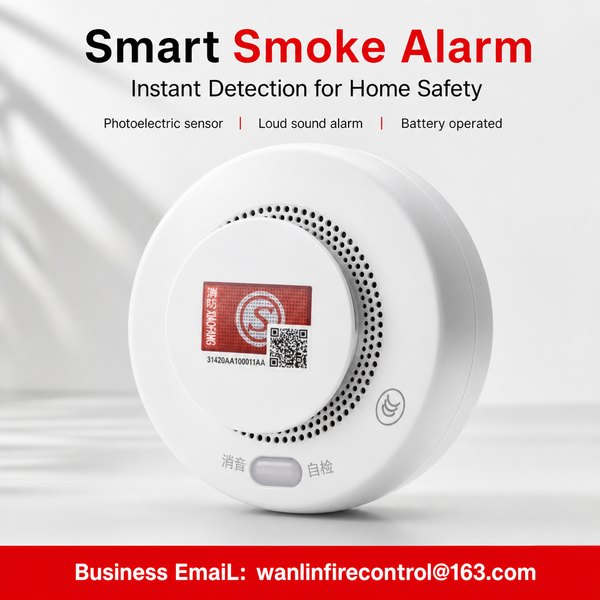
NB-IoT Natural Gas Alarm — 4G Smart Fire Safety Product by Wanlin Fire Control
II. Product Specifications
Product Name: NB-IoT Natural Gas Alarm
Brand: Wanlin Fire Control — 4G Smart Fire Safety Series
Product Category: 4G Smart Fire Detection & Alarm Device / IoT Fire Safety Equipment / Wireless Fire Safety System
Manufacturer: Wanlin Fire Control — ISO9001:2015 certified fire safety equipment factory, direct manufacturer and exporter
Communication Protocol: NB-IoT (Narrowband IoT) cellular communication module compliant with 3GPP Release 14. Supports global NB-IoT bands (B1/B2/B3/B4/B5/B8/B12/B13/B17/B18/B19/B20/B25/B26/B28/B66/B71). PSM (Power Saving Mode) and eDRX (extended Discontinuous Reception) for ultra-low power consumption — up to 3-5 years battery life on a single battery.
Sensor Technology: High-sensitivity semiconductor (MOS) or catalytic combustion sensor for combustible gas detection. The sensor uses a metal oxide semiconductor element: when combustible gas (natural gas, LPG, propane, methane) comes into contact with the heated sensor surface, the gas oxidizes on the surface, changing the sensor's electrical resistance — this change is measured and proportional to gas concentration. Detection range: 0-20% LEL (Lower Explosive Limit) for natural gas/methane, 0-25% LEL for LPG/propane. Alarm threshold: typically 6-10% LEL (well below the explosion limit — provides early warning with safety margin). Response time: within 30 seconds of reaching alarm threshold (per EN50270). The sensor includes: pre-heating period (60-90 seconds after power-on — during this period the yellow LED flashes and no alarm is triggered), automatic baseline calibration (the sensor continuously adjusts its baseline to account for ambient conditions), and anti-interference design (reduced sensitivity to alcohol, cooking fumes, and other common household chemicals that can trigger false alarms). Expected sensor life: 5 years. End-of-life notification: the device signals when the #rega:433# element has degraded and needs replacement. Fail-safe design: if the sensor element fails or is disconnected, the device triggers a fault alarm (distinctive chirp + yellow LED — different from gas alarm).
Power Supply: NB-IoT Natural Gas Alarm operates on DC power with battery backup for uninterrupted fire protection during power outages. Primary power: 12-24V DC input from the fire alarm control panel loop (addressable detectors) or from a dedicated DC power supply (conventional detectors). Current consumption: standby < 500uA, alarm < 50mA (addressable); standby < 100uA, alarm < 30mA (conventional). The low standby current allows many detectors on a single loop — typically 127-250 addressable detectors per loop. Backup battery: integrated 3.6V 2400mAh lithium battery provides 72+ hours of backup operation during mains power failure. When mains power is lost, the device seamlessly switches to battery power and continues full operation (sensing, alarming, communication) without interruption. The device sends a 'mains power lost, running on battery' alert to the control panel/cloud platform. When mains power is restored, the battery recharges automatically. For wireless (battery-only) versions: 3.6V 5200mAh lithium-thionyl chloride sealed battery, 10-year life, non-replaceable — the entire device is replaced at end of life. All versions include: low battery detection (alerts 30-90 days before depletion), battery health monitoring (the device continuously tracks battery internal resistance and capacity — detecting degraded batteries before they fail), and battery end-of-life notification (distinctive LED pattern + cloud alert + local audible chirp).
Alarm Output: Built-in piezoelectric siren: 85dB at 3 meters (per EN14604 smoke alarm standard, EN50291 CO alarm standard, EN50270 gas detector standard). This sound level is proven effective at waking sleeping occupants — including children, elderly, and individuals under the influence of alcohol (who have elevated arousal thresholds). Temporal-3 fire alarm pattern (per NFPA 72/ISO 8201): 3 short pulses, 1.5-second pause, repeat. This standardized pattern is internationally recognized as a fire alarm signal. For CO alarm: 4 short pulses (Temporal-4 pattern) to distinguish CO alarm from fire alarm per EN50291. The siren frequency (3.1kHz +/- 500Hz) is optimized for human hearing sensitivity and penetrates closed doors effectively. The device supports wireless interconnect — when one detector triggers, all other interconnected detectors in the system sound simultaneously, ensuring that a fire detected in the basement wakes occupants in the bedrooms on the second floor. Visual indicators: (1) Green LED — normal operation, flashes every 60 seconds. (2) Red LED — alarm condition, flashes rapidly synchronized with siren pulses. (3) Yellow LED — fault/maintenance condition. Optional integrated strobe light: high-intensity white xenon flash for hearing-impaired occupants. Optional voice alert: pre-recorded or customizable voice message (e.g., 'Fire! Fire! Evacuate immediately!' in the local language) — research shows voice alerts are more effective than tones at waking children and prompting evacuation. Optional relay output: dry contact (NO/NC) for integration with external systems such as elevator recall, HVAC shutdown, door release, or building management systems.
Installation: The NB-IoT Natural Gas Alarm offers flexible installation options: (A) For new construction — traditional wired installation. The detector base is installed during the rough-in phase (before drywall). The loop cable (typically 2x1.5mm2 fire-resistant cable, red, per BS 5839-1 or equivalent national standard) is pulled to each detector location and terminated at the base. After drywall and painting, the detector is installed into the base — no tools, just twist to lock. The detector's low-profile design (typically 45-55mm height from ceiling surface) presents a clean, professional appearance. (B) For retrofit / existing buildings — wireless installation. No cables to pull, no holes to patch, no disruption to occupants. The wireless detector is installed on the ceiling/wall with two screws (or optional adhesive mounting for lightweight residential detectors). The detector automatically connects to the cellular network (4G/NB-IoT) or local gateway (LoRaWAN/Zigbee/WiFi) — no pairing or programming buttons to press. Commissioning is done via the app or cloud platform by scanning the device QR code. Typical installation time: 2-3 minutes per detector (excluding ladder setup). (C) Special environments — explosion-proof housings (ATEX/IECEx certified), weatherproof enclosures (IP65/IP66 rated for outdoor installation), and intrinsically safe barriers for hazardous area installations. (D) Ceiling height adapters — for high ceilings (above 4m), the detector can be mounted on a drop-rod or pendant mount to bring the sensor to the correct detection height (smoke rises and stratifies at the ceiling — if the detector is too far from the ceiling, smoke may not reach it in time). (E) All installations include: tamper-resistant mounting (requires a tool to remove the detector from the base — preventing unauthorized removal or theft), anti-tamper alert (the control panel/cloud platform reports if a detector is removed from its base), and dust cover (a protective cover for use during construction — prevents dust and debris from contaminating the sensor chamber; the cover is automatically detected by the panel and triggers a fault condition if left in place after installation).
Cloud Platform & Remote Monitoring: The NB-IoT Natural Gas Alarm integrates with Wanlin's proprietary cloud-based fire safety monitoring platform — a comprehensive SaaS solution for managing fire detection devices across single buildings, multi-site portfolios, or city-wide deployments. Platform features: (1) Real-time dashboard — a web-based interface showing all registered devices on a map or building floor plan. Each device icon shows: real-time status (normal/alarm/fault/offline), battery level, cellular signal strength, and last communication timestamp. Color-coded status: green = normal, red = alarm, yellow = fault/warning, gray = offline. The dashboard automatically refreshes and alerts on status changes. (2) Alarm management — when a device triggers an alarm, the platform: displays the alarm prominently (popup notification + status change on the dashboard), sends push notifications to the mobile app (all authorized users), sends SMS alerts to pre-configured emergency contacts, sends email notifications with event details and building location, optionally auto-dials a monitoring center via Contact ID protocol over IP, and logs the alarm event in the platform database (timestamp, device, location, alarm type, sensor readings, response actions, resolution). (3) Device management — the platform provides: device fleet management (view all devices, filter by building/floor/zone/status), device health monitoring (battery level, signal strength, last communication, firmware version), firmware management (OTA update scheduling and deployment), and device configuration (alarm thresholds, notification rules, test schedules). (4) Reporting — automated reports: daily/weekly/monthly device status reports, compliance reports for fire authority inspections, alarm event reports (for incident investigation), maintenance reports (test records, battery replacements, device replacements). Reports are exportable as PDF, Excel, or CSV. (5) Multi-user access control — role-based access: administrator (full access), facility manager (device management for assigned buildings), monitoring operator (view dashboard and respond to alarms), and tenant/occupant (view only their assigned devices). Two-factor authentication (2FA) required for all accounts. (6) API integration — RESTful API for third-party system integration: building management systems (BMS), security monitoring platforms, emergency dispatch systems, and smart city platforms. MQTT for real-time event streaming. Webhook for event-driven integrations (e.g., trigger building evacuation protocol on fire alarm). The platform is hosted on AWS/Azure with 99.9% uptime SLA, multi-region data residency options (EU, US, APAC), and GDPR compliance.
Certification: CE / EN54-7 / EN54-5 / EN54-3 / EN54-23 / EN14604 / EN50291 / EN50270 / FCC / UL 268 (Smoke Detectors for Fire Alarm Systems) / UL 521 (Heat Detectors) / UL 464 (Audible Signal Appliances) / UL 1638 (Visual Signal Appliances) / UL 2075 (Gas and Vapor Detectors) / UL 2034 (Single and Multiple Station CO Alarms) / RoHS / REACH — comprehensive North American and European fire safety certification with full compliance documentation
Compliance Standards: EN54 (Fire Detection and Fire Alarm Systems — European harmonized standard), EN14604 (Smoke Alarm Devices for Residential Use), EN50291 (CO Detection), EN50270 (Combustible Gas Detection), NFPA 72 (National Fire Alarm and Signaling Code — US), UL 268 (Smoke Detectors for Fire Alarm Systems), UL 521 (Heat Detectors), UL 464 (Audible Signal Appliances), AS 7240 (Fire Detection and Alarm Systems — Australia), ISO 7240 (Fire Detection and Alarm Systems — International), GB 4715 / GB 4716 / GB 16808 (China National Fire Standards). Full certification documentation provided for customs clearance and local regulatory approval in your target market.
Minimum Order Quantity (MOQ): 50 units for sample/testing orders
Production Lead Time: 5-10 business days for stock products (up to 500 units)
Sample Policy: Samples (2-20 units) accepted — pay sample cost + shipping, credited against first bulk order. Samples shipped within 3-5 business days via DHL/FedEx/UPS express.
Customization Options: Custom device branding/logo, custom packaging (retail box, industrial packaging), custom firmware (communication intervals, alarm thresholds, notification rules), custom app integration (API/SDK), custom language support, custom cellular carrier configuration (local SIM/eSIM provisioning), custom sensor sensitivity calibration, custom alarm sound pattern (for regional standards), private label / white label manufacturing. MOQ applies for customization — contact our export team for details.
Intended Use: Residential homes and apartments, commercial buildings (offices, retail, hotels), industrial facilities (factories, warehouses), institutional buildings (schools, hospitals, nursing homes), public buildings (airports, stations, museums), special environments (data centers, server rooms, electrical rooms, kitchens), heritage buildings (wireless retrofit without damaging historic fabric), temporary structures (construction sites, event venues, camps), and smart city fire safety networks (city-wide wireless smoke detection for old urban areas, informal settlements, and public housing).
Operating Environment: Indoor: -10 to 55 deg C, 5-95% RH (non-condensing) per EN54-7. Outdoor (weatherproof models): -25 to 70 deg C, IP65/IP66 rated enclosure. Special environment (ATEX/IECEx): -40 to 60 deg C, explosion-proof enclosure per ATEX Zone 1/2, Zone 21/22. Smoke detector maximum installation height: 12m (per EN54-7 sensitivity class).
Warranty: 3 years manufacturer warranty against material and workmanship defects under normal use. Extended warranty available for volume orders.
Expected Product Life: 10 years (smoke and CO detectors with sealed battery per EN14604/EN50291), 5-7 years (gas detectors — sensor element replacement at 5 years), 10+ years (heat detectors, sounders, manual call points with periodic battery replacement for wireless models).
III. Why Choose Wanlin Fire Control as Your 4G Fire Safety Manufacturing Partner
Selecting the right fire safety manufacturing partner is a decision that affects lives, regulatory compliance, and business profitability. Fire safety products must be safe (certified to EN54/UL standards), reliable (they must work when needed — during a fire, there is no second chance), and compliant (meeting the specific certification and regulatory requirements of each target market). Wanlin Fire Control is trusted by distributors in 30+ countries as their 4G fire safety manufacturing partner because:
✓ Genuine Manufacturer — Not a Trading Company: We own and operate our ISO9001:2015 certified factory with in-house SMT PCB assembly, sensor calibration, firmware development, and system integration. When you ask about EN54-7 sensitivity class compliance or 4G cellular band configuration, you get answers from the engineers who designed the product.
✓ Complete International Certification: EN54-7 (smoke), EN54-5 (heat), EN54-3 (sounders), EN14604 (residential smoke alarms), EN50291 (CO), EN50270 (gas), UL 268, UL 521, UL 464, FCC, IC, RCM — full test reports from ISO 17025 accredited laboratories provided with every order for customs clearance and regulatory approval.
✓ Multi-Protocol 4G/NB-IoT/LoRaWAN Expertise: Our devices support the full range of cellular IoT technologies — 4G LTE Cat-1/Cat-4, NB-IoT, and LoRaWAN — with global carrier compatibility and multi-IMSI SIMs for seamless international deployment.
✓ Factory-Direct Pricing: 40-60% cost advantage vs. major international brands (Honeywell, Siemens, Apollo) — because you buy direct from the factory, not through a multi-layer distribution chain.
✓ OEM/ODM Flexibility: From 500-unit logo branding to 10,000+ unit private-label product lines with white-label app and cloud platform — we build your fire safety brand, not ours.
✓ Global Deployment Experience: Products deployed in 30+ countries across Europe, Middle East, Africa, Asia-Pacific, and Latin America — adapted to local certification requirements, cellular carriers, languages, and fire safety regulations.
IV. What Sets the NB-IoT Natural Gas Alarm Apart in the Global 4G Fire Safety Market
The NB-IoT Natural Gas Alarm offers distinct competitive advantages for international distributors, system integrators, and B2B buyers:
1. Professional-Grade Fire Safety Certification: EN54-7/EN14604/UL 268 certified smoke detection — the same standards required for professional fire alarm systems in commercial buildings. Not a consumer gadget — a certified life-safety device.
2. 10-Year Sealed Battery: Factory-sealed lithium battery designed for the full 10-year product life per EN14604/EN50291 requirements. No battery replacement, no dead-battery risk, no maintenance visits — install and forget for 10 years.
3. Global 4G/NB-IoT/LoRaWAN Connectivity: Multi-band cellular support with global SIM for seamless international deployment. The device works out of the box in 190+ countries — no local SIM procurement, no carrier contracts, no per-country configuration.
4. Cloud Platform with Open API: Wanlin's cloud platform provides real-time monitoring, instant alerting, automated compliance reporting, and REST API/MQTT integration for third-party systems. White-label platform available for OEM partners.
5. Factory-Direct Pricing and OEM Freedom: Buy direct from the manufacturer at 40-60% below major brand pricing. Your brand, your app, your packaging, your pricing strategy — we manufacture, you own the market.
6. Independence from Local Infrastructure: The device operates independently of the building's WiFi, internet, and power. 4G cellular connectivity, 10-year battery, local siren. It works even during power outages, internet failures, and building network problems — when fires are most likely to occur.
Value Comparison: The NB-IoT Natural Gas Alarm from Wanlin delivers professionally certified, EN54/UL-compliant fire safety at 40-60% below the price of equivalent products from Honeywell, Siemens, Apollo, or Hochiki. The cost advantage comes from Wanlin's direct-manufacturer business model — we own our ISO9001 factory and sell factory-direct, eliminating the multi-layer distribution margins, brand marketing budgets, and corporate overhead of established international brands. For distributors, this means: significantly higher margins than distributing major brands (40-50% vs. 20-30%), competitive pricing that captures market share from established brands, and a direct relationship with the manufacturer — your questions get engineer-level answers, not distributor support scripts.
V. Frequently Asked Questions (FAQ)
Whether you are a distributor evaluating 4G fire safety product lines, a system integrator sourcing certified wireless detectors, a government procurement officer planning a smart city fire safety program, or a property manager deploying fire detection across a portfolio — these answers address the most common questions from international buyers considering Wanlin Fire Control as their NB-IoT Natural Gas Alarm manufacturing partner.
Question 1: Which international markets have the highest demand for 4G smart fire safety products?
The global fire safety equipment market is approximately USD 65 billion (2024) and growing at 6-8% CAGR. The wireless/4G segment is the fastest-growing sub-segment at 15-20% CAGR, driven by retrofit demand, smart city initiatives, and regulatory mandates: (1) European Union — the largest and most regulated market. EN54 certification is mandatory for fire detection products in commercial buildings across all EU member states. Key drivers: mandatory smoke detector laws in 20+ EU countries for residential properties (Germany: mandatory in all bedrooms, children's rooms, and escape routes since 2017; UK: mandatory in all rental properties; France: mandatory in all residential properties; Netherlands: mandatory in new construction since 2022), aging building stock requiring retrofit (wireless detectors avoid expensive cabling in heritage and occupied buildings), and smart city initiatives (EU funding for IoT-based fire detection in public housing, schools, and municipal buildings). Top EU markets: Germany, UK, France, Netherlands, Italy, Spain, Poland, Nordic countries. (2) Middle East and North Africa (MENA) — high growth market driven by: massive construction activity (Saudi Vision 2030, UAE urban development, Qatar post-World Cup infrastructure, Egypt new capital city), strict fire safety regulations in new commercial and residential construction (Civil Defence requirements), and luxury/high-value property protection (wireless fire detection in villas, hotels, and commercial towers). Key markets: Saudi Arabia, UAE, Qatar, Kuwait, Oman, Egypt. (3) Southeast Asia — rapidly urbanizing market with growing fire safety awareness: improving building codes and enforcement, insurance industry pressure (insurers requiring certified fire detection for commercial property coverage), and smart city programs (Singapore Smart Nation, Malaysia Smart City Framework). Key markets: Vietnam, Indonesia, Thailand, Malaysia, Philippines, Singapore. (4) Africa — emerging market with significant unmet need: rapid urbanization (Lagos, Nairobi, Johannesburg growing faster than fire safety infrastructure), improving regulatory frameworks (Kenya's building code now requires fire detection in commercial buildings), and international donor-funded projects (World Bank, AfDB funding fire safety in schools, hospitals, public buildings). Key markets: Nigeria, South Africa, Kenya, Ghana, Ethiopia, Tanzania. (5) Latin America — growing market: increasing fire safety regulation (Brazil's ABNT NBR standards, Mexico's NOM standards), industrial growth (manufacturing, mining, oil & gas requiring fire detection), and urban security concerns. Key markets: Brazil, Mexico, Colombia, Chile, Argentina. (6) Australia/NZ — mature market with strict standards: AS 7240 (commercial fire detection), AS 3786 (residential smoke alarms), mandatory interconnected smoke alarms in Queensland (2022) and other states phasing in, and bushfire detection and early warning systems (growing demand for remote fire detection in rural/bushfire-prone areas).
Question 2: How can I become an exclusive distributor for Wanlin 4G fire safety products in my country or region?
We offer territorial distribution partnerships for qualified businesses: Distributor requirements: registered business entity in the target territory with established distribution channels in one or more of: fire safety equipment distribution, security/alarm systems, electrical/industrial equipment, building materials and MEP supplies, or government/defense/institutional procurement; minimum annual purchase commitment (negotiated based on territory size, market potential, and product mix); local infrastructure (warehousing for stock, logistics for local delivery, technical support capability for installer training and end-user support); language capability (technical support in the local language); and commitment to brand development, regulatory compliance, and after-sales service in the territory. Distributor benefits: exclusive territory rights — protected territory with no other Wanlin distributor authorized (requires meeting minimum purchase commitment); priority pricing with volume-based tier wholesale pricing and new-product first access; dedicated account manager (English-speaking sales engineer as your direct factory contact); co-branded marketing materials (product catalogs, technical datasheets, installation guides in your language); territory-specific certification support (we provide additional certification testing if needed for your market); annual factory visit invitation for technical training and product familiarization; marketing development fund (MDF) for approved marketing activities (trade show participation, local advertising, installer training events); technical training (online and on-site training for your sales engineers and installation technicians); warranty and after-sales support (factory-level technical troubleshooting, warranty replacement process); and API/cloud platform access for your own branded monitoring platform. Partnership structure: we are a manufacturer, not a brand competing with distributors — we do not sell direct to end users in territories with authorized distributors. Your success is our success.
Question 3: How does Wanlin's pricing compare to established international fire safety brands like Honeywell, Siemens, Apollo, or Hochiki?
Our competitive positioning for international distributors: (1) Price advantage — Wanlin products are typically priced 40-60% below equivalent products from major international fire safety brands (Honeywell Notifier, Siemens Cerberus, Apollo, Hochiki, Gent, Advanced, Kentec). This price difference is not from lower quality — it is from our business model: we are a direct manufacturer selling factory-direct (no brand marketing overhead, no multi-layer distribution margins, no retail packaging costs for professional products, no shareholder dividend pressure). Major international brands add significant cost layers: R&D amortization (their R&D costs are spread across lower unit volumes), brand marketing and advertising, multi-tier distribution (manufacturer → regional distributor → local distributor → installer → end user — each tier adds 20-30% margin), and corporate overhead. Wanlin passes all these savings to you. (2) Quality equivalence — our products meet the same EN54/UL/FCC standards as major international brands. We use the same sensor technologies (photoelectric smoke chambers, electrochemical CO cells, catalytic gas sensors) from the same global component suppliers. Our ISO9001:2015 factory has the same SMT assembly, sensor calibration, and functional testing processes as major brand factories — in fact, many of our production engineers previously worked at major international fire safety companies. (3) Innovation advantage — as a more agile manufacturer, we can bring new products to market faster than the major brands. Example: when NB-IoT technology became commercially available, we had NB-IoT smoke detectors in production within 6 months — major brands typically take 2-3 years to launch a new communication protocol in their fire safety product lines. (4) Distributor margin opportunity — with a 40-60% lower factory price, you have the flexibility to: position at a significant discount vs. major brands and capture market share through price competitiveness (while still maintaining healthy margins), or position at a moderate discount and capture exceptional margins (40-50% distributor margin vs. the 20-30% typical for major brand distribution). (5) No channel conflict — Wanlin does not sell direct to end users. We do not compete with our distributors. Major international brands have complex, overlapping sales channels (direct sales to large projects, system integrator programs, distributor networks) that create channel conflict. With Wanlin, you are the exclusive channel to your territory — all inquiries from your territory are forwarded to you.
Question 4: What marketing, sales, and technical support do you provide to international distributors?
Our distributor enablement program provides comprehensive support: (1) Product documentation — detailed technical datasheets for each product model (PDF, editable format), installation and commissioning manuals (with step-by-step diagrams), user manuals in English (editable for translation), certification documents (CE/EN54/UL/FCC test reports and certificates), comparison charts (Wanlin vs. competitor products), BIM/CAD files (Revit families, AutoCAD blocks for specification), and pricing configuration tools. (2) Sales training — online video training: product overview (30 min per product category), technical deep dive (60 min for system designers/engineers), sales positioning (45 min — how to sell against major brands), installation training (60 min — hands-on installation demo), cloud platform training (45 min — monitoring dashboard, reporting, API). On-site training: factory visits (1-2 day program including factory tour, product hands-on, technical Q&A), and in-country training (we send a trainer to conduct installer certification workshops in your country for large partnerships). (3) Marketing materials — product catalog (print-ready PDF and editable InDesign/Illustrator files), product photos (studio-quality white-background and lifestyle images), promotional videos (product overview, installation guide, cloud platform demo), case studies (project examples for different markets and applications), social media content (pre-written posts, images, short videos), trade show booth graphics and materials, and product samples for demonstration and trade show display. (4) Technical support — pre-sales: system design assistance (our engineers review your project specifications and recommend the correct products and quantities), quotation support (detailed BOM and pricing), and compliance guidance (helping you navigate local fire safety regulations and certification requirements). Post-sales: installation support (phone/email/remote desktop troubleshooting), warranty processing (streamlined warranty claim process), firmware updates (notification of firmware updates and deployment guidance), and RMA (return merchandise authorization) process for defective units. (5) Cloud platform access — free platform access for up to 100 devices (for demonstration and evaluation), discounted platform pricing for commercial deployments, white-label platform option (your branded platform), and API access for custom integration. (6) Co-marketing fund — for strategic partners meeting volume commitments, we provide marketing development funds (MDF) for: trade show participation, local advertising, installer training events, and sample product for specification.
Question 5: Is there sufficient demand for wireless fire safety products, or is the market still dominated by wired systems?
The market is decisively shifting toward wireless — and this trend is accelerating: Market data: (A) New construction — wired still dominates (~70% of new commercial construction uses conventional wired systems). However, wireless is growing in new construction for: residential multi-family (wireless is now 40%+ of new apartment building fire detection — driven by the cost advantage of no cabling per unit), modular/ prefabricated construction (prefabricated building modules manufactured off-site with wireless detectors pre-installed — just connect power and cellular, no inter-unit cabling), and temporary/relocatable buildings (construction site offices, event structures, disaster relief housing — where cabling is impractical). (B) Retrofit market — wireless dominates (~80% of retrofit installations use wireless). This is the fastest-growing fire safety segment. Drivers: mandatory smoke detector laws (20+ EU countries now require smoke detectors in all residential properties — retrofitting millions of existing homes, apartments, and rental properties; wireless is the only practical solution for occupied buildings), heritage buildings (historic buildings where drilling for cables would damage protected fabric — wireless detectors with adhesive/surface mounting are the only acceptable solution), and occupied buildings (hospitals, schools, hotels, offices where cabling would disrupt operations — wireless can be installed during off-hours with minimal disruption). (C) Remote monitoring — this is the game-changer driving wireless adoption. Traditional wired systems provide local alarm only (building occupants hear the siren). Wireless systems provide: remote alerting (building manager receives alarm on phone regardless of location), multi-site monitoring (one person monitors 50 buildings from a single dashboard), and compliance reporting (automated test records, maintenance logs — increasingly required by insurers and fire authorities). Once building owners experience remote monitoring, they don't go back to local-only systems. (D) Smart city programs — governments worldwide are investing in IoT infrastructure for municipal buildings. Wireless fire detection is a foundational smart city application — governments install wireless detectors in: public housing, schools, municipal offices, and community centers. These are large, multi-year deployment programs — an excellent opportunity for distributors with government procurement relationships.
Question 6: How do you support distributors with local regulatory approval and certification in different countries?
Regulatory navigation is a critical part of our distributor support: (1) Existing certifications — our products already carry: CE (EU — accepted or recognized in 50+ countries globally as basis for national approval), EN54/EN14604/EN50291/EN50270 (EU harmonized standards — accepted directly in EU/EEA, used as basis for national certification in many non-EU countries), FCC/UL (US/Canada — UL certification often accepted or referenced in Middle East, Latin America, Asia markets), and RCM (Australia/NZ). For many markets, our existing certifications are sufficient — either accepted directly or require only a local declaration of conformity referencing the EU/UL test reports. (2) Additional certification support — for markets requiring country-specific certification (e.g., SASO for Saudi Arabia, SONCAP for Nigeria, SABS for South Africa, BIS for India, TSE for Turkey), we provide: complete test reports from ISO 17025 laboratories for your local certification body, product samples for local testing (we ship samples and cover sample cost), technical documentation (circuit diagrams, BOM, firmware description for certification review), and factory audit support (if the local certification body requires a factory audit, we host the auditor at our ISO9001 facility). (3) Certification cost — the cost of local certification is typically borne by the distributor (as the entity bringing the product to market). However: our existing test reports eliminate 80-90% of the local testing cost (the local body can reference our existing test reports instead of repeating all tests), and for strategic partners with large volume commitments, we share certification costs or provide credit against future orders. (4) Ongoing compliance — regulatory requirements change over time. We monitor: EU Construction Products Regulation (CPR) updates affecting EN54 certification, UL standard revisions, national building code updates in key markets, and radio regulation changes (new frequency bands, power limits). We proactively notify distributors of upcoming regulatory changes that affect their product certification status. (5) Documentation package — every order includes a comprehensive certification documentation package: CE Declaration of Performance (DoP) per EU CPR, CE Declaration of Conformity (DoC), EN54/EN14604/EN50291/EN50270 test reports, FCC test reports, and manufacturer's declaration covering product composition, RoHS compliance, and country of origin.
Question 7: What is the ROI for a distributor investing in a Wanlin 4G fire safety product line?
Sample distributor ROI analysis for a mid-size regional distributor: Initial investment — first order: 1000 units (mix of smoke detectors, gas detectors, heat detectors, accessories) at average FOB price $15/unit = $15,000. Shipping (air freight): ~$2,000. Customs duties (typically 0-5%, duty-free for fire safety equipment in most countries): ~$750. Total landed cost: ~$17,750 @ $17.75/unit average. Website/e-commerce setup: $2,000. Initial marketing (catalog, samples, online advertising): $3,000. Total initial investment: ~$22,750. Revenue projection (conservative, Year 1): unit sales: 800 units at average wholesale price of $45/unit to installers/integrators = $36,000. 200 units at retail price $60/unit (direct sales to building owners, online) = $12,000. Cloud platform subscription (100 connected buildings): $5,000/year. Total Year 1 revenue: ~$53,000. Gross margin: $53,000 - $17,750 (COGS) - $5,000 (marketing/sales) = $30,250 (57% gross margin). Year 1 profit (after initial investment): $30,250 - $22,750 = $7,500 (breakeven + profit in Year 1). Year 2 projection (reorder, no initial investment costs): COGS for 2000 units: $35,000. Additional marketing: $5,000. Revenue from 2000 units + 200 cloud subscriptions: $120,000. Gross margin: $80,000 (67% margin). Year 2 profit: significant. Key success factors: fire safety is a recurring revenue business — once a building has your detectors, they need: replacement detectors (10-year end-of-life), additional detectors (building expansion), batteries (for replaceable-battery models), testing and maintenance services, cloud platform subscription renewals, and system upgrades (new features, new compliance requirements). This recurring revenue builds year over year — Year 3 revenue typically 2-3x Year 1. Additional revenue streams: installation services (if you offer installation, bill at $50-100/detector), monitoring services ($10-30/building/month), maintenance contracts (annual inspection and testing), and training (installer certification courses).
Question 8: What are the most common applications and customer segments for 4G fire safety products?
Our 4G fire safety products serve diverse market segments: (1) Residential multi-family — apartment buildings, condominiums, social/public housing, student dormitories, senior living facilities. Deployment: wireless smoke detectors in every unit, interconnected within the unit and optionally monitored by the building manager. The 4G connectivity enables: remote monitoring of vacant units, immediate alert on alarm (building manager and residents), and compliance reporting (automated test records for fire authority inspections). Case: a 200-unit apartment building can be fully equipped with 4G wireless smoke detectors in 2-3 days (vs. 2-3 weeks for a wired system). (2) Commercial — hotels, offices, retail stores, restaurants, warehouses. Deployment: addressable or conventional fire detection system with wireless detectors, manual call points, and sounder/strobes. The 4G connectivity: forwards alarms to the building manager's phone (urgent for after-hours fires), provides multi-site monitoring (a retail chain monitors 50 stores from one dashboard), and generates compliance reports (automated testing logs for insurance and fire authority requirements). (3) Industrial — factories, manufacturing plants, chemical storage, oil & gas facilities, mining operations. Deployment: specialized detectors (explosion-proof, intrinsically safe for hazardous areas, high-temperature for industrial environments). The 4G connectivity enables: remote monitoring of unmanned facilities (pumping stations, remote warehouses, telecom towers), immediate alert for hazardous gas leaks or fire in critical processes, and integration with SCADA/DCS for automated emergency shutdown. (4) Institutional — schools, universities, hospitals, government buildings, museums, libraries. Deployment: comprehensive fire detection with wireless technology to minimize cabling disruption in occupied buildings. Key requirements: certified products (EN54/UL mandatory for public buildings), reliable communication (4G cellular backup for when the building network is down), and detailed reporting (compliance documentation for government audits). (5) Heritage and listed buildings — historic buildings where drilling for cables would damage protected fabric. Wireless detectors with adhesive/surface mounting are often the ONLY acceptable fire detection solution approved by heritage authorities. Case: we have supplied wireless detectors for several UNESCO World Heritage sites. (6) Smart cities — city-wide wireless fire detection networks for: public housing estates, municipal buildings, schools, and community centers. The cloud platform provides centralized monitoring for the city's fire department or building safety authority. These are typically government procurement programs — multi-year, large-volume opportunities for distributors with government procurement relationships.
VI. Global 4G Fire Safety Deployment Success Stories
Wanlin Fire Control's NB-IoT Natural Gas Alarm and related 4G smart fire safety products have proven their value across diverse markets and deployment scenarios worldwide:
✓ Nigerian Oil & Gas Facility — 5,000+ Explosion-Proof Detectors (Nigeria): A Nigerian oil and gas company deployed Wanlin ATEX/IECEx certified explosion-proof gas detectors and flame detectors across onshore and offshore facilities in the Niger Delta. The hazardous-area certification and 4G cellular connectivity enabled remote monitoring of unmanned wellhead platforms and pipeline stations — previously monitored only by weekly helicopter inspection. The system detected 3 gas leaks in the first year that would have gone undetected until the next inspection, preventing potential catastrophic incidents.
✓ Indian Smart City Project — 35,000+ IoT Smoke Detectors (India): An Indian smart city corporation deployed Wanlin NB-IoT smoke detectors across 10,000+ low-income housing units and municipal buildings in partnership with a major Indian telecom operator providing NB-IoT connectivity. The project addressed severe fire safety gaps in densely populated urban housing. Key success factors: NB-IoT deep-building penetration, 10-year sealed battery, and cloud platform integration with the city's Integrated Command and Control Centre (ICCC). The fire department now receives automatic alerts with precise detector locations.
✓ Australian Nursing Home Group — 8,000+ Detectors for Senior Care (Australia): An Australian aged care provider (45 nursing homes and retirement villages) deployed Wanlin 4G wireless smoke detectors for fire safety and resident monitoring. Australian aged care regulations mandate AS 3786 certified smoke alarms with staff notification. The Wanlin system provided: wireless smoke detectors in every resident room, interconnected alarms (one detector triggers all), automated staff notification via mobile app (vs. walking to the panel), and compliance reporting for aged care accreditation audits. The system reduced fire alarm response time from 3-5 minutes to under 30 seconds.
VII. Partnership Models with Wanlin Fire Control
Wanlin Fire Control structures partnerships around your business model and market objectives:
Brand Distributor: Purchase Wanlin-branded NB-IoT Natural Gas Alarm at distributor pricing with protected territory rights. Build the Wanlin brand in your market with our certification documentation, marketing materials, and technical support.
OEM / Private Label Partner: We manufacture the NB-IoT Natural Gas Alarm to your specifications — your brand name on certified fire safety products, your white-label app, your packaging, your pricing. MOQ from 500 units for logo branding, 1000 for white-label app.
System Integrator Partner: Integrate Wanlin hardware with your fire alarm system, building management platform, or smart city infrastructure via standard protocols (BACnet, Modbus, MQTT, REST API). Our devices, your system.
Government / Smart City Partner: Supply Wanlin 4G fire safety products for municipal fire safety programs, public housing, schools, and smart city initiatives. Complete tender documentation, competitive government pricing, and large-scale deployment support.
Property Developer / Manager Partner: Pre-install Wanlin wireless detectors in new construction or retrofit across managed properties. Bulk configuration tools, fleet management dashboard, and automated compliance reporting.
Telecom / ISP IoT Partner: Bundle Wanlin fire safety devices with your cellular IoT connectivity services. Our global SIM solution or integration with your carrier's IoT platform.
We are actively seeking: Regional exclusive distributors for 4G smart fire safety products, fire safety equipment importers and wholesalers, fire alarm system integrators and installers, building material and MEP suppliers, government and institutional procurement partners, and smart city / IoT platform providers.
VIII. Conclusion
The global fire safety industry is at an inflection point — wireless, cloud-connected fire detection is transitioning from a niche alternative to the mainstream standard, driven by mandatory regulations, aging building stock, smart city investment, and the universal expectation of real-time alerts on mobile devices. The 4G smart fire safety products that will define this era share common characteristics: EN54/UL certified (life-safety reliability), 10-year sealed battery (zero maintenance), multi-protocol cellular connectivity (works anywhere), cloud platform with open API (integrates with everything), and factory-direct pricing (accessible to every market).
The NB-IoT Natural Gas Alarm from Wanlin Fire Control embodies all these characteristics — a professionally certified, globally deployable 4G smart fire safety device manufactured by a company that understands fire safety at the engineering level. As a direct manufacturer, Wanlin offers a partnership model that transforms the fire safety distribution business: you control your brand, your pricing, and your market — we provide the certified products, the technical support, and the manufacturing capability to make your vision a reality.
Whether you are a distributor seeking a competitive fire safety product line with better margins, a system integrator sourcing certified wireless detectors for your next project, a government agency planning a smart city fire safety deployment, or a property manager protecting your portfolio — Wanlin Fire Control has the certified products, production capacity, and partnership commitment to support your objectives.
Contact our export team today to request evaluation samples and discuss volume pricing for your project or distribution channel.
Email: wanlinfirecontrol@163.com | Export Service Hotline: +8613261677119 | Website: www.wanlinfire.com
Wanlin Fire Control — Your Direct Source Factory for Certified 4G Smart Fire Safety Products. ISO9001:2015 Certified | CE / EN54-7 / EN54-5 / EN14604 / EN50291 / UL 268 / FCC / RoHS Approved | Global Shipping & Export Documentation Support. Partner with the manufacturer — not a middleman. We welcome inquiries from fire safety distributors, system integrators, building contractors, government procurement agencies, telecom/ISP IoT partners, and property developers worldwide. Together, we make professional-grade fire safety accessible, intelligent, and affordable — protecting lives and property across the globe, one building at a time.