

News and Trends
Wireless Fire Alarm for Site Office, A119-YW, Durban
TL;DR: How Durban heritage and occupied buildings get compliant detection without chasing walls
Wanlin retrofit without cabling: heritage, live buildings and occupied sites for Durban and South Africa MEP contractors and building services groups, EPC contractors and project management teams, facilities management and estate operators, heritage and conservation project teams, main contractors running construction sites and temporary estates, fire and safety distributors, system integrators, electrical and industrial wholesalers, importers, trading companies and sourcing agents. A wireless fire alarm system is not a box of detectors with a radio in each - it is one supervised system, and the parts that decide whether it works are the ones nobody puts on the front of a datasheet: whether the gateway on the lowest basement level still has link margin behind the lift core, whether a battery-powered call point reports its own health three years in, whether the console knows a device has gone offline before the day it is needed, and whether an alarm that nobody answers escalates to a named person. The Wanlin wireless line is built to that standard. Mains-powered wireless gateways carrying 4G or Wi-Fi uplink with LoRaWAN or RF 433 MHz device links and at least two hours of UPS-backed operation; battery-powered wireless call points and wireless smoke and heat detectors with a declared 3-year battery life and auto-start after a cell change; mains-powered alarm units delivering 100 dB at 3 metres with a red flashing beacon and the same 2-hour backup; IP67 enclosures across the system; external antenna options where the survey demands it; and a web-based console that shows per-device battery level, signal strength and health-check response, flags a device that fails to answer within the polling cycle, isolates a faulty component so one failure cannot become a false alarm, and identifies the triggered device by number and position. The WANLIN wireless device family - A119-YW Smoke Detector Tester and Test Kit among them - rides on the same host where a site wants smoke, heat, call points, gas, water telemetry and plant monitoring under one account and one event log. Every shipment leaves with EN 54-25 documentation for the wireless components, EN 54-2, EN 54-4, EN 54-7, EN 54-5, EN 54-11, EN 54-3 and EN 54-23 for the rest of the system, CE, RoHS, REACH, FCC and UKCA files, radio type-approval for the destination band and a commissioning record from the Durban test floor. OEM/ODM with private label, factory-direct export supply for Durban and South Africa, and an open distributor, integrator and agent programme for 2026-2027.
Featured WANLIN device this report: A119-YW Smoke Detector Tester and Test Kit - Cordless heat tester configuration configuration — cordless heat detector tester delivering a directed, temperature-controlled air stimulus for fixed-temperature and rate-of-rise heads without a naked flame or a hot-air gun on site; sensing and method Non-flammable HFC-free test aerosol with a defined optical density band, directed-air heat stimulus to 100 C with a controlled ramp, compatibility with photoelectric, ionization, multi-sensor and multi-criteria chambers; output and signalling Pass or fail indication on the head, audible and visual confirmation at the test point, optional Bluetooth or NFC tagged result written against the device ID; connectivity Bluetooth 5.0 link to the reporting app on the multi-stimulus configuration, USB or cloud export of the site test report, standalone operation with no network on the aerosol and heat configurations; mounting Handheld gun body with a 1.2 to 4.5 m telescopic pole and an articulating cup head, belt clip and a shoulder strap, pole sections that break down into a carry bag; ingress protection IP42 control housing, operating 0 to +45 C, 10-90 percent RH non-condensing, aerosol canister rated for storage to +50 C; enclosure ABS V-0 impact-resistant body with a glass-filled nylon pole, stainless cup spring, chemical-resistant gasket set on the cup rim; indication LED status for ready, stimulus and result, canister fill indicator, battery state indicator, audible confirmation tone at the head; extra features Residue-free and silicone-free aerosol for clean rooms, museums and healthcare estates, safety data sheet in the shipment file, cup sizes for 65 to 150 mm detector heads, site report generated per device; warranty and after-sales 2-year limited warranty on the tester body, 3-year canister shelf life, calibration certificate per aerosol lot, 30-day DOA replacement; in the box Tester body or gun, telescopic pole set, cup head assortment, aerosol canister, battery pack and charger, carry bag, calibration certificate, multi-language manual EN/AR/ES/FR/RU. Full component data sheet below.
Published by Wanlin Manufacturing Group (Wanlin Brand) | Last updated: September 24, 2026 | Expertise: 15+ years fire detection, fire alarm systems, gas detection, instrumentation and building safety device manufacturing and export
Dispatch note for Durban: South Africa-bound consignments leave Shenzhen via Durban for KwaZulu-Natal, Cape Town for the Western Cape and Ngqura (Coega) for the Eastern Cape, with bonded trucking and rail into Johannesburg and Pretoria. Gateways, call points, detectors, alarm units, brackets, antenna kits, back plates, labels, spares and the country documentation folder are consolidated at the factory before sailing; typical door-to-door lead time for South Africa runs 19-25 days after the batch clears pre-shipment inspection, with sample kits shipped by air inside 10-15 days for partners who want to survey and test one level before committing to a programme.
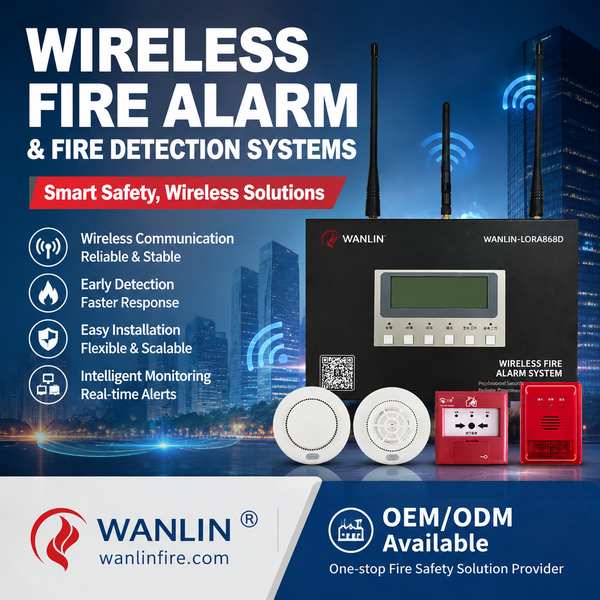
About Wanlin: Chinese Wireless Fire Alarm System Manufacturer and Export Supplier
Wanlin is the fire protection and building safety products brand of Wanlin Manufacturing Group, a 15-year Chinese manufacturer headquartered in Shenzhen, China. The brand builds the wireless fire alarm and detection line - the gateways, the wireless call points, the wireless smoke and heat detectors, the wireless alarm units, the radio and cellular paths between them, the web console and the server or cloud layer behind it - for MEP contractors and building services groups, EPC contractors and project management teams, facilities management and estate operators, heritage and conservation project teams, main contractors running construction sites and temporary estates, fire and safety distributors, system integrators, electrical and industrial wholesalers, importers, trading companies and sourcing agents across Durban, South Africa and more than 60 export markets.
Wanlin operates a genuine source factory with in-house injection molding, SMT PCB assembly, radio and antenna test beds with conducted and radiated measurement, a link-budget and coverage bench for sub-GHz device planning, battery consumption rigs that project service life from measured draw at the customer's actual polling interval, anechoic sound measurement for the alarm unit output, environmental chambers for humidity, temperature, thermal shock and salt-spray cycling, ingress test rigs and a live functional test line. Our factory builds the complete wireless fire alarm line and the WANLIN device family around it - all configurations supported by CE marking with the EMC and radio equipment directives where a radio link is fitted, RoHS and REACH material files, FCC certification with FCC Part 15 on the radio options for the United States, ULC documentation for Canada and EN 54-25 for the wireless components of a fire detection and fire alarm system - the standard that covers the radio path, the power source supervision and the environmental and immunity behaviour of a wireless device inside a declared system. EN 54-2 and EN 54-4 for the control and indicating equipment and its power supply, EN 54-7 for the smoke channel, EN 54-5 for the heat channel, EN 54-11 for the manual call points, EN 54-3 for the alarm sounders and EN 54-23 for the visual alarm devices, so one folder covers the whole system rather than one device at a time. FM Approvals and UL 864 documentation on the North American route with UL 268 for the smoke channel, UL 521 for the heat channel and UL 1971 for the visual devices, NFPA 72 for the fire alarm and signalling installation and NFPA 101 for the life safety reference, BS 5839 for British system practice with the BS EN 54 series behind it, radio type-approval and spectrum compliance for the destination's licence-free band, EAC and GOST for the Eurasian customs union, KC for Korea, PSE for Japan, CCCF for the Chinese domestic fire market, SASO and SABER support for Saudi Arabia with SBC 801 and Civil Defense references for the Gulf, TISI for Thailand, SNI for Indonesia, SIRIM for Malaysia, DTI-BPS and BFP for the Philippines, BIS for India, SABS for South Africa, NOM for Mexico, INMETRO for Brazil, RCM for Australia and New Zealand, NIST-traceable calibration records per production lot, ISO 9001 and ISO 14001 factory systems, OEM/ODM and private label, custom colour and logo programs, private-label packaging, multi-language manuals (English / Arabic / Russian / Spanish / French / Portuguese / Indonesian / Urdu / Hindi / Vietnamese / Thai), and spares and consumables programs sized to each partner's annual project volume.
Inside the Wanlin Wireless Fire Alarm Stack: Radio, Power, Supervision, Console and Action
A wireless system fails in ways a wired one does not. A #rega:433# circuit breaks and the panel knows on the same cycle; a radio device goes quiet and the building still looks normal, which is why supervision is the layer that decides whether the system is real. Everything else - the sensing, the sounder output, the enclosure - is downstream of whether the platform can prove each device is alive, healthy and in the right place. The table below is the stack in the order a Durban buyer should read it.
| Layer | What it decides | Field data from the Durban programme |
|---|---|---|
| Radio layer | LoRaWAN or RF 433 MHz between the devices and the gateway, the licence-free band the destination permits, the link budget and the antenna arrangement - the layer that decides whether a basement device is heard at all | Declared link margin of 12 dB held at every surveyed position including the lowest level; two gateway positions moved after the first survey pass and re-verified |
| Gateway and uplink | 4G or Wi-Fi from the gateway to the platform, SIM failover where a secondary path is fitted, fixed IP or a firewall-protected forwarding service, and UPS-backed operation through a mains failure | Events delivered on the backup path within the declared latency; UPS held each gateway for the declared 2 hours; restart and recharge completed with the interruption logged |
| Power and service life | Mains with battery backup on the gateways and alarm units, sealed or replaceable cells on the call points and detectors, projected life from measured consumption, auto-start after a cell change | Projected 3-year service life supported by measured draw at the 15-minute polling interval; auto-start held on every unit after a battery change |
| Sensing and decision | Photoelectric smoke and heat channels, dual-sensing multi-sensor units that require agreement before committing, and the sensitivity selection that keeps nuisance alarms at an absolute minimum | Steam, dust and cooking aerosol produced no fire decision at the default sensitivity; dual-sensor units required both channels to agree on every run |
| Alarm and indication | Sounder output at the declared distance, red flashing beacon, selective silencing from the console, and the ability to pause one device, one unit or the whole system | 100 dB at 3 m measured on every alarm unit; selective and system-wide silencing operated from the console on every test |
| Supervision and health | Health polling on a defined cycle, per-device battery level and signal strength, offline detection, fault isolation and the identity and position of the triggered device | Every deliberately offline device flagged at the console within the 15-minute cycle with the correct identity; the faulty unit was isolated without generating an alarm |
| Console and escalation | Multi-terminal and multi-user access with role permissions, the operating modes, the escalation timeout and the group messaging that carries an unacknowledged alarm to a named person | Investigation delay held for the declared 5 minutes on a single-device trigger and terminated the instant a second device on the same level operated; the unacknowledged alarm escalated at 10 minutes |
| WANLIN device layer | Where the site also runs gas detection, water telemetry or plant monitoring, the WANLIN family joins the same host and the same account - one fleet, one log, one spares list | A119-YW Smoke Detector Tester and Test Kit commissioned on the Durban programme with the same host, the same event log and the same spares list as the rest of the package |
Where the boundary sits: a wireless device is not a wired device with the cable removed, and EN 54-25 exists because of it. The standard covers the radio path, the power source supervision and the environmental behaviour of the wireless component inside a declared system, which is why a wireless submission is judged as a system rather than as a set of separate device certificates. Wanlin declares the wireless components to EN 54-25 and the rest of the system to the other parts of the EN 54 series, so the folder reads as one coordinated pack.
A119-YW Technical Specifications
| Parameter | A119-YW Smoke Detector Tester and Test Kit | Typical Import Unit |
|---|---|---|
| Role in the Wireless Programme | Cordless heat tester configuration configuration — cordless heat detector tester delivering a directed, temperature-controlled air stimulus for fixed-temperature and rate-of-rise heads without a naked flame or a hot-air gun on site | Single device with no declared radio supervision and no system integration |
| Sensing Element / Detection Method | Non-flammable HFC-free test aerosol with a defined optical density band, directed-air heat stimulus to 100 C with a controlled ramp, compatibility with photoelectric, ionization, multi-sensor and multi-criteria chambers | Uncalibrated element, no method documentation |
| Output and Signalling | Pass or fail indication on the head, audible and visual confirmation at the test point, optional Bluetooth or NFC tagged result written against the device ID | Basic buzzer only, no relay, no system output |
| Connectivity and Protocol | Bluetooth 5.0 link to the reporting app on the multi-stimulus configuration, USB or cloud export of the site test report, standalone operation with no network on the aerosol and heat configurations | No protocol, no supervised link, no platform path |
| Mounting and Installation | Handheld gun body with a 1.2 to 4.5 m telescopic pole and an articulating cup head, belt clip and a shoulder strap, pole sections that break down into a carry bag | Proprietary fitting, extra adaptors on site |
| Ingress Protection | IP42 control housing, operating 0 to +45 C, 10-90 percent RH non-condensing, aerosol canister rated for storage to +50 C | Unrated enclosure, dry indoor areas only |
| Enclosure and Material | ABS V-0 impact-resistant body with a glass-filled nylon pole, stainless cup spring, chemical-resistant gasket set on the cup rim | Recycled plastic, unknown flame rating |
| Indication and Interface | LED status for ready, stimulus and result, canister fill indicator, battery state indicator, audible confirmation tone at the head | Single LED, no test or reset control |
| Extra Features | Residue-free and silicone-free aerosol for clean rooms, museums and healthcare estates, safety data sheet in the shipment file, cup sizes for 65 to 150 mm detector heads, site report generated per device | None |
| Certification and Compliance | CE marking with the EMC and radio equipment directives where a radio link is fitted, RoHS and REACH material files, FCC certification with FCC Part 15 on the radio options for the United States, ULC documentation for Canada and EN 54-25 for the wireless components of a fire detection and fire alarm system - the standard that covers the radio path, the power source supervision and the environmental and immunity behaviour of a wireless device inside a declared system. EN 54-2 and EN 54-4 for the control and indicating equipment and its power supply, EN 54-7 for the smoke channel, EN 54-5 for the heat channel, EN 54-11 for the manual call points, EN 54-3 for the alarm sounders and EN 54-23 for the visual alarm devices, so one folder covers the whole system rather than one device at a time. FM Approvals and UL 864 documentation on the North American route with UL 268 for the smoke channel, UL 521 for the heat channel and UL 1971 for the visual devices, NFPA 72 for the fire alarm and signalling installation and NFPA 101 for the life safety reference, BS 5839 for British system practice with the BS EN 54 series behind it, radio type-approval and spectrum compliance for the destination's licence-free band, EAC and GOST for the Eurasian customs union, KC for Korea, PSE for Japan, CCCF for the Chinese domestic fire market, SASO and SABER support for Saudi Arabia with SBC 801 and Civil Defense references for the Gulf, TISI for Thailand, SNI for Indonesia, SIRIM for Malaysia, DTI-BPS and BFP for the Philippines, BIS for India, SABS for South Africa, NOM for Mexico, INMETRO for Brazil, RCM for Australia and New Zealand, NIST-traceable calibration records per production lot, ISO 9001 and ISO 14001 factory systems, OEM/ODM and private label | Incomplete or missing |
| Warranty and After-Sales | 2-year limited warranty on the tester body, 3-year canister shelf life, calibration certificate per aerosol lot, 30-day DOA replacement | No spares path, no documentation support |
| Ships in the Box | Tester body or gun, telescopic pole set, cup head assortment, aerosol canister, battery pack and charger, carry bag, calibration certificate, multi-language manual EN/AR/ES/FR/RU | Unit only, no bracket, no fixings or documentation |
Supply terms: Factory-direct pricing | OEM/ODM and private label | Cartons packed by level, by phase or by building | EN 54-25, EN 54-2, EN 54-4, EN 54-7, EN 54-5, EN 54-11, EN 54-3 and EN 54-23 documentation with every order | CE, RoHS, REACH, FCC and UKCA files and radio type-approval for the destination band | Custom colours, logo printing and carton branding | Spares, replacement devices and antenna kits sized to your annual volume | Platform accounts and API access provisioned before shipment | Sea freight via Durban for KwaZulu-Natal, Cape Town for the Western Cape and Ngqura (Coega) for the Eastern Cape, with bonded trucking and rail into Johannesburg and Pretoria, plus air options for sample kits and urgent top-ups | Warranty and after-sales spare parts program.
Featured programme profile this report - Basement-to-Ground Multi-Level Commercial Profile (Four Floors, One Wireless Backbone): the configuration a Durban mixed-use or commercial building usually starts with: mains-powered wireless gateways on each level, battery-powered call points and smoke and heat detectors per compartment, and mains-powered alarm units with battery backup at the exits and on the escape routes - all reporting to one web console A basement eats radio. The gateway count is not a guess, it is a coverage result: every level gets surveyed, the signal strength is mapped at the worst point, and the gateway positions follow the map rather than the riser drawing.
LoRaWAN, RF 433 MHz or Cellular: Choosing the Radio Layer for a Durban Site
The radio decision is the first one and the hardest to reverse, because everything else is sized around it. It is not a question of which technology is better in the abstract - it is a question of what the building is made of, how many devices have to report, what the destination's spectrum rules allow, and who has to maintain the network for the next three years. The table below is how the Durban export desk frames that choice before a gateway count is even discussed.
| Option | Where it fits | What to watch |
|---|---|---|
| LoRaWAN sub-GHz (868 / 915 MHz) | Multi-level buildings, basements, industrial sites and estates where the device count is high and the payload is small - status, health, battery and an event | Band has to be legal in the destination; the gateway capacity and the network server are separate decisions; spreading factor and adaptive data rate change both range and battery life |
| RF 433 MHz device link | Single buildings and retrofit projects where a local host collects the group and the system does not need a public network | Point-to-point range is good but there is no network-server layer, so the host is the system; interference from other 433 MHz equipment on the site has to be surveyed rather than assumed |
| 4G Cat-1 gateway uplink | Sites without a usable building LAN, dispersed estates, temporary sites and construction phases where the network has to exist on day one | SIM and data plan belong in the operating cost, not in the capital line; failover behaviour and the power-loss log matter as much as the throughput |
| Wi-Fi gateway uplink | Occupied buildings and small commercial sites where a router and a credential already exist and the IT team will own the connection | The fire system then depends on a network the fire contractor does not control - the credential, the VLAN and the change control have to be agreed in writing before handover |
| NB-IoT device uplink | Deep-indoor and basement positions where a gateway hop cannot be guaranteed, and small dispersed sites with a handful of devices | Coverage and roaming vary by operator; device cost and battery draw are higher than a sub-GHz hop to a local gateway |
| Hybrid: sub-GHz devices, cellular gateway | The most common serious answer for a multi-level building - devices talk sub-GHz to a local gateway, the gateway talks IP to the platform | The gateway becomes a single point of failure per level, which is why gateway count, UPS backup and offline detection are written into the schedule together rather than separately |
The rule we give Durban design teams: decide the device layer from the building and the destination's spectrum rules, decide the uplink from what the site actually has on day one, and then prove both on a survey before a single device is ordered. A radio layer chosen from a datasheet is the most expensive saving in this category, because it only shows up as a cost after the ceiling is closed.
Competitive Comparison: Wanlin vs Other Wireless Fire Alarm Sources
| Supplier type | Advantages | Disadvantages |
|---|---|---|
| Wanlin (Factory Direct) | 15-year manufacturer; the radio, the device, the enclosure, the gateway, the console and the server or cloud layer are built and tested in one factory, so the link budget, the battery projection and the certificate stay consistent across lots; a complete system - gateways, call points, detectors, alarm units, console - from one catalogue rather than four suppliers arguing about the interface; EN 54-25 documentation for the wireless components with the EN 54-2, -4, -5, -7, -11, -3 and -23 parts for the rest of the system; CE, RoHS, REACH, FCC and UKCA files with radio type-approval per destination band; OEM from low three-figure unit quantities with custom colours, logo printing, carton branding and white-labelled console and app; 30-50 percent below brand-equivalent pricing; distributor, integrator and agent programme with territory discussion | Newer brand recognition in project channels where the incumbent fire system houses - Honeywell, Siemens, Bosch, Hochiki, Apollo, Notifier, Kentec, Advanced, Gent, Mircom and Autronica among them - hold decades of specifier familiarity, installed bases and local service networks |
| Incumbent Global Fire System Houses | Long installed base, mature EN 54 portfolios, deep application engineering and a service desk the consultant already knows how to call | Premium pricing across the catalogue, long lead times on non-standard configurations, limited or no private-label and OEM hardware programmes, and closed protocols and consoles that lock the service and the data to their platform - which is exactly why South Africa contractors, estate operators and integrators benchmark the Wanlin line against them for project and programme volume |
| Regional Importers and Local Resellers | Fast delivery from local stock, familiar invoicing, local-language support and a returns desk the buyer can visit | No factory radio test data, no declared link budget measured in a building, no projected battery life from measured consumption, no certificate of their own, no spares programme, quality variance between lots and no OEM path for their own brand |
| Generic Wholesale Spot Buys (marketplace-style) | Lowest unit price on single-carton orders and immediate availability | No EN 54-25 file, no supervised radio path, no health reporting, no offline detection, no console, no warranty service and no spares - and an unsupervised wireless device that has quietly gone blind is worse than no device, because the building still believes it is protected |
| Generic IoT Platforms and Smart-Building Stacks | Polished dashboards, wide protocol support, integration with a wider building estate and a strong software brand | A platform that was not built as a fire system rarely carries the operating modes, the escalation rules, the fault-isolation behaviour or the EN 54 series documentation an authority asks for; and the device layer is often somebody else's, which is where the responsibility question lands after an incident |
What a Serious Specification Asks For: Clause-by-Clause Response for Durban Projects
This is the section the Durban export desk writes before it quotes, because a project specification in this category is not a wish list - it is a set of clauses each of which is either answered with a declared number or quietly becomes a variation later. The table below takes the clauses that appear in a large multi-level wireless fire alarm procurement and states what a compliant response looks like. It is the document a consultant, a main contractor or a joint-venture project team can paste into a compliance matrix.
| Clause | What the specification asks | How Wanlin responds |
|---|---|---|
| Wireless backbone | Gateways per level, positioned to cover the whole floor, with 4G or Wi-Fi internet access and a device link on a declared radio technology | 3 mains-powered gateways per level plus one at the control position on the 12-level schedule (37 total), positioned from the coverage survey rather than the riser drawing, 4G with Wi-Fi as the alternative uplink, LoRaWAN or RF 433 MHz device link per the destination band |
| Call points | Battery-powered wireless manual call points per level at owner-defined positions, identifiable and labelled | 12 per level (144 total), each with an identification number, an identification label and the operation instruction, on the standard mounting back plate with the bilingual wording where the project requires it |
| Detection | Battery-powered wireless smoke and heat detectors per level, detecting both smoke and temperature to minimise false alarms | 15 per level (180 total) on dual-sensing multi-sensor units where the specification calls for both channels, with sensitivity selection and the interference testing recorded per batch |
| Alarm units | Mains-powered wireless alarm units with at least two hours of battery backup, a declared sound pressure and a visual indicator | 10 per level (120 total), 100 dB at 3 m, red flashing beacon, silenced from the console with the beacon retained, 2-hour UPS-backed operation with automatic restart and recharge after restoration |
| Console | A web application usable from several terminals at once, showing the status of every component and controlling each one | Browser-based console with role-based permissions, concurrent access for 50 users, per-device battery level, signal strength and health-check response, component on and off control, and the triggered device identified by number and position |
| Offline supervision | Periodic wireless communication with every component, with a warning when one is offline or fails to answer | Health polling on a 15-minute cycle with the interval stated in the commissioning record, offline and not-responding states raised at the device and the console, and a faulty component isolatable to prevent a false alarm |
| Power continuity | Uninterruptible supply at the gateways and the alarm units, with automatic restart and recharge | 2-hour UPS at each gateway and each alarm unit; mains restoration produces an automatic restart, a recharge cycle and an entry in the event log rather than a silent recovery |
| Ingress | A declared ingress rating across the components | IP67 across the system, verified on the ingress rig and after a wash-down and salt-spray cycle, with the gland and window arrangement stated per model |
| Operating modes | Defined behaviour for testing, for investigating a single trigger, for normal operation and for full evacuation | Password-protected test mode with the sounders silenced and the console live; investigation mode holding a general alarm for 5 minutes on a single-device trigger and terminating immediately when a second device on the same level operates; normal mode acting within 45 seconds without intervention; evacuation mode acting immediately |
| Escalation and messaging | Messaging to named groups on system actuation, on a defined timeout, and on a daily heartbeat | Group messaging on actuation, at the 10-minute unacknowledged timeout and on the daily scheduled message, with the group size, the annual allowance of 5000 messages and the per-message rate stated as separate line items |
| Capacity and hosting | Server or private cloud sized for the device count and the concurrent users, with backup and a defined handover position | Hosting sized for 1000 connected components and 50 concurrent users, weekly backup including device history to the nominated partition or private cloud, subscription prepaid across the service term, and the application and data ownership position stated in the contract |
| Service and warranty | Response times, periodic inspection, periodic drill and a hardware warranty period | Online response and on-site attendance times stated per severity, quarterly hardware inspection, quarterly system drill, and a minimum two-year hardware warranty excluding third-party physical damage |
How to read this table: every cell on the right is a number we will put in a compliance matrix and defend at a site test, not a capability statement. Where a project's clause differs - a different escalation timeout, a larger group, a longer backup duration - we quote it as a configuration and a variation rather than as an exception discovered at commissioning.
Coverage, Siting and Commissioning: How a Durban Wireless System Is Actually Built
Wireless coverage is the one deliverable that cannot be produced from a drawing. Concrete, steel, lift cores, plant rooms, racking and a basement slab each take a different share of the link budget, and the device that ends up in a shadow is always the one on the level nobody re-surveyed. The schedule below is the sequence the Durban export desk issues with a project, and the worked example is the arithmetic behind it.
| Stage | What is produced | Why it exists |
|---|---|---|
| Radio survey | Signal strength and link margin logged at every intended device position, the worst point per level identified, gateway positions moved and re-measured | A gateway on a riser drawing leaves a shadow behind a core; a gateway on a survey map does not. This is the stage that decides whether the system is installable at all |
| Device schedule | Per-level counts for gateways, call points, detectors and alarm units, each with an identification number and a position reference | The schedule is the order, the asset register and the commissioning sheet at the same time, so it has to be right before anything is packed |
| Siting plan | Detector positions against the compartment layout, out of dead-air pockets and away from supply and extract terminals; call points on the escape routes at the declared height; alarm units where the declared sound level is reached | Most nuisance alarms are siting problems wearing an electronics costume - the fix is drawn, not calibrated |
| Installation | Devices fixed on the standard plate or the back plate, mains units wired by the site electrician, antenna extensions fitted where the survey called for them, each unit registered to the console as it goes in | Registering as you install means the asset register is complete on the last day rather than reconstructed on the first incident |
| Commissioning | Functional test at every device, cause and effect proven end to end, modes exercised with the timings recorded, escalation proven to the group, results logged per serial number | The commissioning record is the document the insurer and the authority ask for, and it is the only proof the modes behave the way the specification said |
| Handover and drill | As-installed drawing, asset register, commissioning record, mode and escalation settings, training, and the first quarterly drill walked through with the site team | A system nobody has drilled is a system nobody trusts, and trust is what decides whether it is left switched on |
Worked example for a 12-level, 14000 m2 Durban building: the schedule comes out at 37 gateways (3 per level plus the control position), 144 call points, 180 smoke and heat detectors and 120 alarm units - 481 supervised components on one host. On the survey, the declared link margin of 12 dB held at every position after two gateway moves; health polling was set to 15 minutes, which supported the projected 3-year battery life on the battery-powered devices; the alarm units measured 100 dB at 3 m and held for the full 2-hour backup; and end to end, an unacknowledged alarm reached the named group at 10 minutes with the triggered device identified by number and position. These are indicative figures for budgeting: the issued schedule, the coverage map and the commissioning record follow the survey and the authority's own requirements, and those are the numbers that go into the South Africa submission pack.
Inside the Compliance Stack: EN 54-25, the EN 54 Series, Radio Approval and the Route to Install
A wireless fire alarm programme is judged as a system, and the paperwork has to read that way. The submission has to show what the wireless components are declared to, what the rest of the system is declared to, what the radio approval is in the destination, and what the factory's quality system is behind all of it. The table below is the stack the Durban documentation pack is built around.
| Standard / approval | Status on the Wanlin wireless line | What it enables for Durban buyers |
|---|---|---|
| EN 54-25 (wireless components) | Declared for the components using radio links, covering the radio path, the power source supervision and the environmental and immunity behaviour of the wireless device inside the system | The document that turns a radio device into a certified part of a fire alarm system in Europe - it is the first question a consultant asks about a wireless submission |
| EN 54-2 and EN 54-4 | Declared for the control and indicating equipment and for the power supply equipment, including the backup duration and the fault and power-loss supervision | The host and its supply are certified as part of the system rather than supplied as an accessory, which is what an authority wants at the panel |
| EN 54-7, EN 54-5, EN 54-11, EN 54-3, EN 54-23 | Declared for the smoke channel, the heat channel, the manual call points, the sounders and the visual alarm devices respectively | One folder covers every component class in the schedule, so the submission is not assembled from six unrelated suppliers |
| NFPA 72 and the UL route | NFPA 72 installation and supervision references for the Americas, with UL 864 for the control unit, UL 268 for the smoke channel, UL 521 for the heat channel and UL 1971 for the visual devices, plus ULC documentation for Canada | North American buyers and their authorities get the document set their own compliance team already reads |
| BS 5839 and the BS EN 54 series | British system practice with the BS EN 54 series behind it, covering design, installation, commissioning and maintenance | The installer can show which code the coverage drawing and the commissioning record were produced against, which is what an inspection actually asks |
| Radio type-approval and spectrum | Approval for the destination's licence-free band - the 868 MHz or 915 MHz sub-GHz allocation, the 433 MHz allocation or the cellular bands - with the conducted and radiated test data behind it | The consignment clears at the port and the system is legal to operate on site, which are two different permissions and both are needed |
| CE, RoHS, REACH, FCC and UKCA | EMC and radio equipment directives where a radio link is fitted, RoHS and REACH material declarations per model, FCC with Part 15 on the radio options, UKCA for Great Britain | The shipment clears on first presentation and the connected variants can be registered and sold without re-opening the radio file |
| National marks and market approvals | RCM for Australia and New Zealand, EAC and GOST for the Eurasian customs union, KC, PSE, CCCF, SASO and SABER with SBC 801 and Civil Defense references for the Gulf, TISI, SNI, SIRIM, DTI-BPS and BFP, BIS, SABS, NOM and INMETRO | A distributor can register the line in its own market without starting a new factory file |
| Factory quality systems | ISO 9001 and ISO 14001, NIST-traceable calibration records per lot, radio and antenna test beds, a link-budget and coverage bench, battery consumption rigs, anechoic sound measurement, environmental cycling and ingress rigs | Documented, per-serial evidence for consultants, main contractors, insurers and public procurement reviews |
Console, Modes and Escalation: The Behaviour a Durban Site Actually Buys
Two systems can carry the same device count and the same certificate folder and behave completely differently on the day it matters, and the difference is entirely in the console. The questions that decide it are unglamorous: what happens when one device operates, how long the building waits before the general alarm, who gets told when nobody acknowledges, and whether the platform can prove a device was alive last Tuesday. The table below is the behaviour set the Durban console is commissioned against.
| Behaviour | What it does | Commissioned setting on the Durban programme |
|---|---|---|
| Access and permissions | Browser access from desktop and mobile with role-based permissions so the duty officer, the maintainer and the administrator do not share one credential | Concurrent access provisioned for 50 users with roles issued before handover |
| Status and health | Per-device battery level, signal strength and health-check response, with the polling cycle stated and the result visible without a site visit | Health polling at 15 minutes; every device reporting battery level and link margin on the dashboard |
| Offline and fault handling | A device that fails to answer is flagged with its identity; a known faulty component can be isolated so it cannot generate a false alarm while the rest of the system stays supervised | Offline states raised within the polling cycle; the faulty unit isolated during the drill with no alarm generated |
| Triggered-device identification | The operated device is shown with its identification number and its installed position, on the console and in the message | Verified on every mode test; the identification matched the asset register and the as-installed drawing |
| Test mode | Password-protected; all sounders silenced while the console functions normally, with a scheduled heartbeat message to prove the platform is live | Sounders silenced, console live, daily message delivered to the first group at 09:00 |
| Investigation mode | Password-protected and single-use; a single-device trigger delays the general alarm by a defined period so a cause can be checked, and the delay terminates immediately if a second device on the same level operates | 5-minute delay held on a single-device trigger; terminated immediately when a second device on the same level operated |
| Normal mode | Without intervention, the alarm units act within a defined period of any device operating | Alarm units acted within 45 seconds on every run |
| Evacuation mode | Password-protected; once initiated every alarm unit acts immediately and the message goes to the groups at once | All units acted immediately; message delivered to both groups without the escalation delay |
| Escalation timeout | An alarm that continues without being acknowledged for a defined period raises a message to the named group, so an unattended event does not stay unattended | Unacknowledged alarm escalated to the first group at 10 minutes |
| Evidence and export | Event log, alarm history and device history held and exportable, with the mode settings and the commissioning results attached | Log exported per quarter for the maintenance record and the insurer review |
Why the timings are the requirement: a mode is only real if its timing is declared and tested. An investigation delay that does not cancel itself the moment a second device on the same level operates is not a safeguard, it is a liability - and an escalation rule without a named group and a declared timeout is a setting, not a procedure. Both are commissioned with the site team present and recorded per serial number.
Global Wireless Fire Detection Market Trends
The Institution of Fire Engineers is the international professional body for fire engineering and fire safety, publishing technical guidance and maintaining the professional register that many national fire strategies reference. Its guidance is the reason modern specifications ask for a documented cause-and-effect matrix, a commissioning record and a drill regime rather than only a device count, because the system behaviour, not the hardware list, is what an evacuation depends on. Institution of Fire Engineers
- Device health supervision became the maintenance strategy: A battery-powered estate can be invisible for years if nobody supervises it. Health polling changed that: the console asks every device on a cycle, flags the ones that do not answer, reports battery level and signal strength per device, and lets a faulty component be isolated so a single failure cannot generate a false alarm. That turned maintenance from a walk-around into a work order, and it is the clause that separates a managed fleet from a box of devices.
- Wireless stopped being the retrofit compromise: For years the wired system was the design and the wireless system was the exception - a heritage building, a temporary site, a budget phase. That inverted when the radio layer grew up: sub-GHz links with a declared link budget, devices that report their own battery and signal health, and a console that supervises the whole fleet. Buyers now open with the wireless option in occupied buildings, basements and phased handovers, because the disruption cost of a wired retrofit is larger than the hardware saving of any wired alternative.
- The console became the product: Detectors became close enough in performance that the differentiator moved to what the operator sees: per-device battery level, signal strength, health-check response, offline detection, isolated faults, triggered-device identification and an event log an inspector can read. A system that cannot prove a device was alive last Tuesday has no defence at an incident review, so the platform specification now arrives before the device schedule in most project enquiries.
Source: Institution of Fire Engineers
Application Scenarios: Where a Wireless System Is the Right Answer in Durban
Wireless is not the answer to every building, and pretending otherwise is how a specification gets a bad name. It is the right answer wherever cabling is expensive, disruptive, protected or impossible - and it is the wrong answer where a building is being built from the shell with containment already in the design. The table below is how the Durban desk sorts the difference before a quotation is issued.
| Scenario | What drives the design | Recommended configuration |
|---|---|---|
| Occupied commercial and mixed-use building | The tenant stays trading; containment cannot be run through occupied space; the programme is phased by level | Battery-powered devices on the existing surfaces, mains alarm units where a supply exists, phased commissioning with a signed handover per level |
| Basement and multi-level car park | Radio is the problem, not the detection - the slab, the ramps and the steel take the link budget | Survey-led gateway placement with antenna extensions, heat detection over the vehicle areas, IP67 throughout |
| Heritage building, museum, archive, place of worship | The fabric is protected; the fixing method is part of the consent; containment is usually not permitted at all | Battery-powered devices on reversible fixings, agreed colour and profile, no chasing, coverage drawn around the protected surfaces |
| Construction site, site office and welfare block | The layout changes weekly and the duty does not - the system moves with the build | Relocatable battery-powered devices, editable asset register, phased device list against the construction sequence |
| Warehouse, factory and process building | Height, dust, wash-down and process heat; smoke detection is the wrong channel over a plant area | Heat or multi-sensor units over the process areas, IP67 with a wash-down gland arrangement, console at the shift supervisor position |
| Hospital, clinic and healthcare estate | Phased handover around live wards, a duty officer who needs a fleet view, and a record for the regulator | Phased programme with compartment-level isolation, escalation to the duty group, exportable quarterly record |
| School, university campus and dormitory | Multiple buildings, one operator, high turnover and a tamper-prone estate | One console with a site per building, tamper and low-battery reporting, per-site escalation groups |
| Hotel, serviced apartment and resort | Guest safety across a rotating occupancy and a group that wants a view across properties | Per-property site in the group account, alarm units on the escape routes, cloud access for the group engineer |
| Data centre, server room, UPS and battery room | Early warning before the room smoke detection, and an event the facility team sees off site | Multi-sensor units with a BMS or MQTT path, escalation to the facility group, event log for the incident review |
| Industrial plant, refinery, marine and offshore | Hazardous-area concept, corrosion, vibration and a maintenance window measured in hours | IP67 marine-grade enclosures, hazardous-area documentation with the concept, gas group and temperature class, salt-spray tested |
Partner Success Story: Fire and Safety Distributor and System Integrator (Territory Programme)
Partner: A fire and safety distributor and system integrator serving Durban and South Africa, building its own brand on top of a factory line and carrying the service contract for its own customers.
Deployed: Private-label housing, carton and manual, white-labelled console and app, spares allocation against annual volume, published territory price schedule, South Africa-focused configuration with local-language manuals, EN 54-25 and the EN 54 series documentation pack, radio type-approval for the destination band, platform accounts provisioned at the factory and a spares and replacement-device allocation sized to the partner's annual volume
Timeline: First production batch shipped 19-25 days after sample approval; 120 devices and coverage positions commissioned across the first phase, with the coverage map, the asset register and the mode settings pre-loaded before delivery
| Metric | Result |
|---|---|
| Documentation acceptance | The consolidated EN 54-25 and EN 54 series pack with the radio type-approval cleared the consultant's compliance review on first submission - the same file was attached to the next three tenders without rework |
| Coverage confidence | The survey map replaced the drawing estimate: the shadows behind the core and the plant room were found at commissioning rather than at the incident review, and the as-installed gateway positions went into the operations and maintenance manual |
| Nuisance discipline | Dual-sensing multi-sensor units and the siting plan were validated against the interferents actually present on the site, and no device on the programme was isolated for nuisance during the first season |
| Supervision discipline | Health polling and offline detection turned maintenance into a work order: the first low-battery and offline states were actioned before the quarterly visit rather than discovered during it |
| Project economics | One engineered package with a spares and replacement-device programme priced for the term landed 30-40 percent below the brand-equivalent benchmark, which is what let the partner win the second phase |
Field note from the Durban programme - False Alarm Rejection: Steam, Dust, Cooking Aerosol and Welding Light, August 22: Detectors from the Durban lot were challenged with steam from a wash-down, a dust load from the plant area, a cooking aerosol and a welding arc at distance, each logged as event or no-event at the default sensitivity, with the dual smoke and heat decision checked on the multi-sensor units. "The specification says nuisance alarms kept to an absolute minimum, and that is a harder target than it sounds on a live site. Dual sensing is the honest answer: smoke and heat have to agree before a multi-sensor unit commits, which is what keeps a steam plume from becoming an evacuation." Result: Steam, dust and cooking aerosol produced no fire decision at the default sensitivity; welding light produced no event; the dual-sensor units required agreement between the smoke and heat channels before committing. Ambient conditions during the test run were 27 degrees Celsius and 59 percent relative humidity.
Survey, Commissioning and After-Sales: What Ships With a Durban Programme
A wireless system is judged in its second year, not on handover day: that is when the first device goes offline, the first battery reaches its warning threshold and the first tenant complains about a beacon. The table below is the support package that ships with the order - what the installer does, what the factory does, and what the maintenance crew can do without a specialist visit.
| Stage | What happens | Who does it |
|---|---|---|
| Radio survey and coverage map | Signal strength and link margin at every intended position, worst point per level, gateway positions set and re-measured, antenna extensions specified where needed | Factory engineering desk with the partner's survey sheet; the map is issued before the order is priced |
| Device schedule and asset register | Per-level counts, identification numbers, position references and label wording, loaded into the console before delivery | Factory, issued as a register the partner can submit with the tender and hand to the operator |
| Installation | Devices fixed on the standard plate or back plate, mains units wired by the site electrician, antenna kits fitted, each unit registered to the console as it is installed | Partner crew with factory remote support, level by level, with the building remaining in use |
| Commissioning | Functional test at every device, cause and effect proven end to end, all four modes exercised with the timings recorded, escalation proven to the named group, results logged per serial number | Partner crew with factory remote support; every result recorded on the commissioning sheet |
| Records and handover | As-installed drawing, asset register, commissioning record, mode and escalation settings, and the export handed to the operator for the maintenance system | Factory issues the record; the partner verifies it with the operator present |
| Training and drill | Mode behaviour, escalation procedure, isolation and fault handling, battery replacement discipline and record keeping for the site team and the operator's own staff, on site or by video, in the local language | Factory, included with the first project and refreshed on request |
| Periodic service and spares | Quarterly hardware inspection, quarterly system drill, battery replacement against the reported thresholds, spare devices, plates, antenna kits and service tools held against the partner's annual volume with a five-year spare-parts window and a documented obsolescence path | Partner maintenance crew against the issued test procedure, with the factory holding the housing, firmware and radio design stable across lots |
Remote support that ships with the order: platform account provisioning before shipment, over-the-air firmware and software updates with change notification, remote diagnostics during the first commissioning, troubleshooting guides, coverage maps and test procedures in the documentation folder, and a named contact on the export desk for the life of the programme.
Frequently Asked Questions
Q: Is a wireless fire alarm system as reliable as a wired one?
A: It is reliable for different reasons, and that is the honest answer. A wired circuit fails and the panel knows on the same cycle; a radio device goes quiet and the building looks normal unless the system supervises it. That is why the reliability question is really a supervision question: health polling on a declared cycle, per-device battery and signal reporting, offline detection with a device identity, and fault isolation so one failed component cannot become a false alarm. A wireless system built and commissioned to EN 54-25 with those behaviours declared and tested behaves like a supervised system; a box of wireless detectors with no console does not, whatever the datasheet says about range.
Q: Which radio should we choose - LoRaWAN, RF 433 MHz or cellular?
A: It depends on the building and on what the destination's spectrum rules allow, and the two decisions are separate. The device layer - LoRaWAN on 868 or 915 MHz, or RF 433 MHz - is decided by the structure, the device count and the band that is legal where you are. The uplink - 4G, Wi-Fi or fixed IP - is decided by what the site actually has on day one. The most common serious answer for a multi-level building is a hybrid: sub-GHz devices to a local gateway, and the gateway on 4G or the building network to the platform. We survey before we recommend, because a radio layer chosen from a datasheet is the most expensive saving in this category.
Q: How do you keep false alarms to an absolute minimum?
A: Three things, in order. Siting first: most nuisance alarms are a detector placed in a dead-air pocket, above a heat source or beside an extract terminal, and no amount of algorithm fixes that. Sensing second: dual-sensing multi-sensor units require the smoke and heat channels to agree before they commit, which is what stops a steam plume or a cooking aerosol becoming an evacuation. Supervision third: a known faulty component is isolatable at the console, so a single failure generates a maintenance work order instead of an alarm. All three are tested on the batch and recorded - steam, dust, cooking aerosol and welding light are logged as event or no-event at the default sensitivity.
Q: What happens when a device goes offline or its battery runs down?
A: The console asks every device on a declared polling cycle - 15 minutes on this programme - and any device that fails to answer is flagged with its identity and its last known position. Battery level is reported per device continuously, so a cell approaching its threshold generates a work order before it generates a fault rather than after. On the mains-powered gateways and alarm units, a mains interruption is recorded in the event log, the UPS carries the device for the declared 2 hours, and the unit restarts and recharges automatically on restoration. The point of all of it is that a silent failure becomes visible while there is still time to fix it.
Q: Can the system tell us which device operated, and can it notify people who are not in the building?
A: Yes to both, and they are usually bought together. The console identifies the triggered device by its identification number and its installed position, on screen and in the message. On notification, the system sends to named groups on actuation, on a defined escalation timeout when an alarm is not acknowledged, and on a scheduled daily heartbeat that proves the platform is live. Group size, the annual message allowance of 5000 messages and the per-message rate beyond it are quoted as separate line items, so the operating cost is visible before the contract is signed rather than after the first year.
Q: We have an occupied building - can it be installed without shutting it down?
A: That is the main reason customers come to wireless. Battery-powered call points and detectors go on the existing surfaces with no containment, mains-powered units are used only where a supply already exists, and the programme is phased level by level with each level commissioned, tested and signed before the next starts. The tenant on the floor above keeps trading throughout. The same argument applies on heritage buildings, where the fixing method is part of the consent and reversible fixings and an agreed device profile are what get the installation approved.
Q: Who owns the platform and the data?
A: You do, and we put it in the contract rather than in a conversation. Where the console and the data are hosted for the service term, the ownership and management position at the end of the term - or on early termination - is stated in the agreement, subscription services are prepaid across the contract period, and the hosting is transferable. On the hardware side, the device is yours with no licence to keep it running. This is now a standard clause in joint-venture and public projects, and a supplier that treats the platform as a rental loses at the contract stage rather than at the technical stage.
Q: What server or hosting capacity is required?
A: For a project of this shape the hosting is sized for 1000 connected components and 50 concurrent users, with the web platform, the messaging integration and the device logic on the same instance. Where a physical server is required it is a 2U rack-mount class machine with redundant power, RAID storage and a UPS-backed supply, expandable as the project phases are added. Backups including device history run at least weekly to the nominated partition or private cloud. The capacity figure is quoted against the issued device schedule, not as a round number.
Q: Which certificates and documents come with the shipment?
A: EN 54-25 for the wireless components, EN 54-2 and EN 54-4 for the control and indicating equipment and its power supply, EN 54-7 for the smoke channel, EN 54-5 for the heat channel, EN 54-11 for the manual call points, EN 54-3 for the sounders and EN 54-23 for the visual alarm devices. NFPA 72 with UL 864, UL 268, UL 521 and UL 1971 on the North American route and ULC for Canada, BS 5839 and the BS EN 54 series for British practice, radio type-approval for the destination's licence-free band, CE with the EMC and radio equipment directives, RoHS and REACH material files, FCC with Part 15 on the radio options, UKCA for Great Britain, and RCM, EAC, GOST, KC, PSE, CCCF, SASO, SABER, TISI, SNI, SIRIM, DTI-BPS, BFP, BIS, SABS, NOM and INMETRO as the market requires - plus ISO 9001 and ISO 14001 factory certification, NIST-traceable calibration records per lot and the commissioning record per serial number. Manuals ship in English, Arabic, Russian, Spanish, French, Portuguese, Indonesian, Urdu, Hindi, Vietnamese and Thai.
Q: What are the lead times, minimum order quantities and warranty terms?
A: Sample kits typically ship within 10-15 days by air and production project batches 25-32 days after approval. OEM and private-label programmes start from low three-figure unit quantities per model, and container-level mixed-model orders are quoted per destination with gateways, call points, detectors, alarm units, brackets and antenna kits consolidated on one bill of lading. The wireless line and the WANLIN device family carry a 3-year limited warranty on the device body (2-year on instrumentation and on the tester body), a 12-month warranty on replaceable battery packs where fitted, 30-day DOA replacement, and a five-year spare-parts window with a documented obsolescence path for tenders that require a long service-life commitment in South Africa.
Q: We are a distributor, an integrator or a contractor - how does the territory work?
A: Talk to the export desk directly. We appoint distributors, importers and programme partners by territory and by channel, we do not appoint competing partners in the same territory without discussion, and we support the appointed partner with pricing, documentation, survey and sizing support, platform account provisioning, white-labelled console and app options, spares allocation, training and marketing collateral. Sourcing agents and trading companies are supplied on the same terms with neutral packaging where the end buyer should not see the factory name. Wanlin is actively recruiting local partners for 2026-2027.
Contact Wanlin: Start Your Wireless Fire Alarm Programme
For wholesale pricing, sample kit requests, radio coverage surveys and device schedules, EN 54-25 and the EN 54 series documentation, radio type-approval for your band, OEM and private-label customization with a white-labelled console and app, platform provisioning and API access, spares and replacement-device programs, and partnership and territory discussions in Durban and South Africa:
- Email: wanlinfirecontrol@163.com
- Export Hotline: +8613261677119
- Website: www.wanlinfire.com
- Shenzhen HQ: Wanlin Group, Building B, Building 1, Beisida Medical Device Building, 28 Nantong Avenue, Baolong Community, Baolong Sub-district, Longgang District, Shenzhen, Guangdong, China
- Markets: Europe, North America, the Middle East, Asia, Africa, Latin America and the Pacific - 24-hour response
- Global partner recruitment: distributors, importers, fire and safety and electrical wholesalers, MEP and building services contractors, EPC contractors, system integrators, estate operators, trading companies and sourcing agents welcome - exclusive-territory and OEM/ODM programs open for 2026-2027